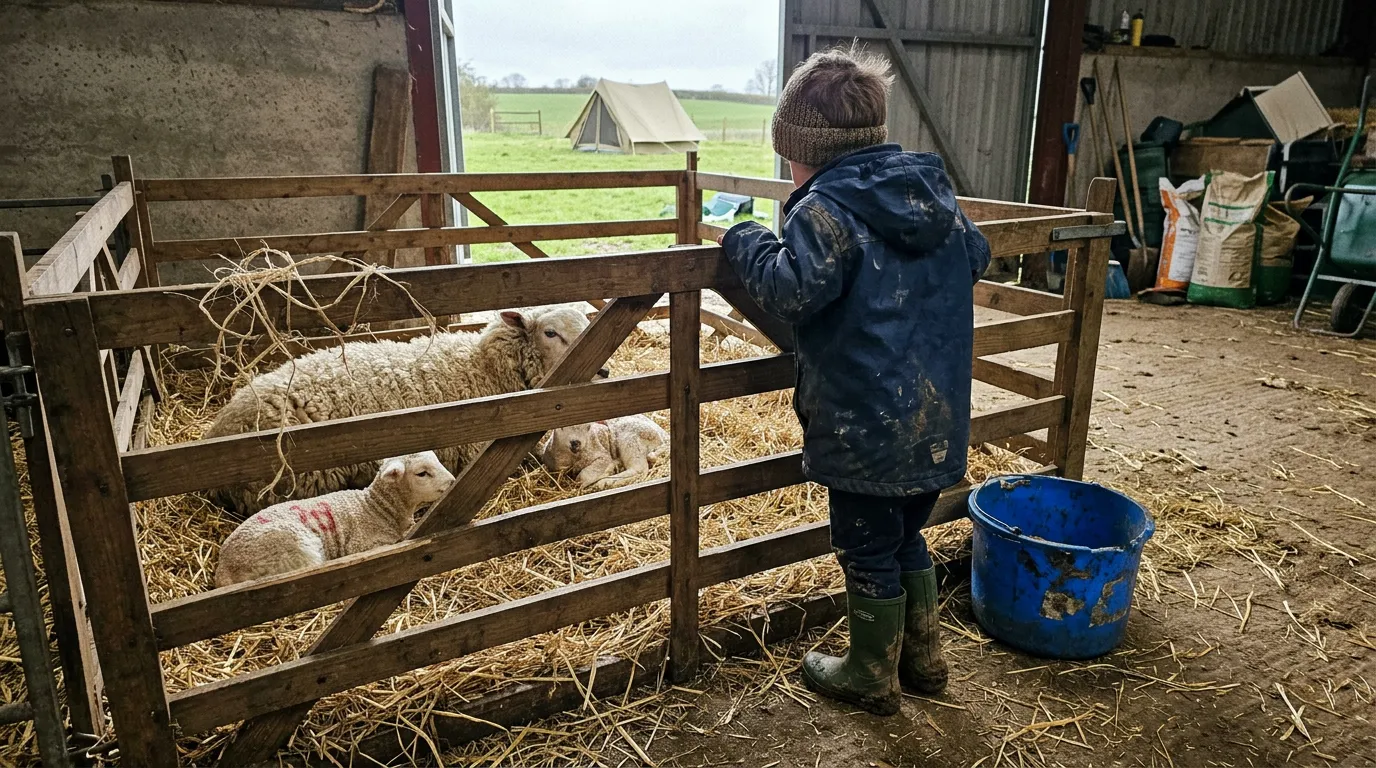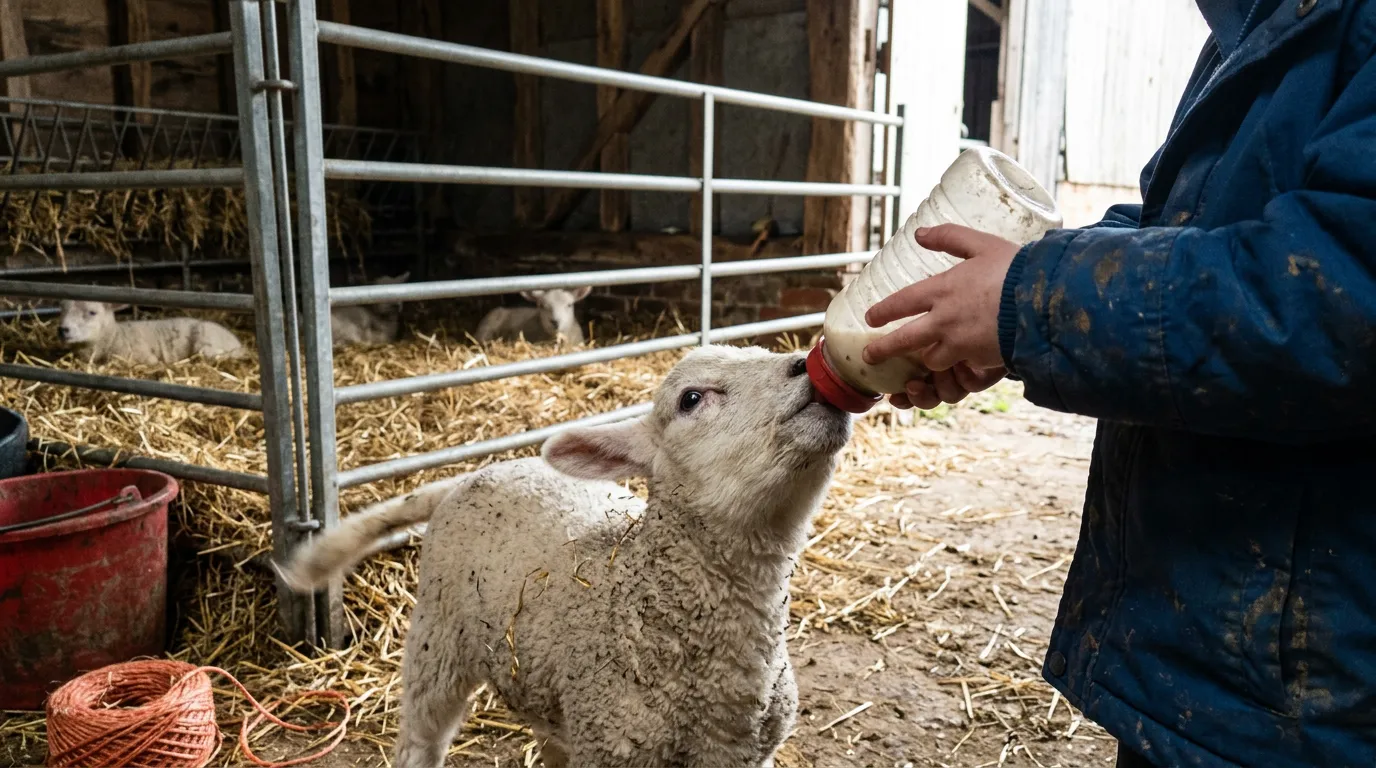
Why some lambs end up on the bottle, how to hold one the right way, how much milk they drink and the farm stays where children can help at feeding time.
The lamb hears the gate before it sees you. By the time you've climbed into the straw pen it's butting at your knees, tail spinning, and when the teat reaches its mouth the bottle nearly leaves your hand. Most children go quiet for a second. Then they laugh, and they don't stop.
That's bottle feeding lambs on a working farm in spring, and it's one of the best reasons to book a family break between March and May. Here's why some lambs end up on the bottle, how to hold one properly, how much milk they drink and which of our farm stays with animals might ask you to lend a hand.
Why do some lambs need a bottle?
Most never see one. They feed from their mother little and often, dozens of times a day, and the farmer leaves them to it.
A few miss out, though. A ewe has two teats, so with triplets the smallest is often taken off and raised by hand, and some young ewes reject a lamb outright or simply don't have enough milk. Farmers call these pet lambs, or cade lambs in some parts of the country. Because they're handled every day, they grow into the friendliest sheep in the flock!
Every newborn needs colostrum, the thick first milk from its mother, within a few hours of birth. After that a bottle lamb lives on ewe milk replacer, a powder mixed with warm water to about body temperature, and never cow's milk from the fridge.
Bottle feeding lambs on a farm stay: what really happens
Forget the booked experience session at a farm park. On a working farm the lambs run to the farmer's clock, usually first thing and again late in the afternoon, so you'll hear a shout across the yard, pull your wellies on at the tent door and follow the bleating to the barn. The farmer mixes the milk in a jug, fills the bottles and hands them out.
Expect chaos for about two minutes.
A hungry lamb pulls hard, pushes up with its head the way it would under a ewe and slops milk down your sleeve. When the bottle's empty it'll suck your fingers, your coat toggle and the hem of your little brother's jumper. Then the whole gang flops down in the straw and the barn goes quiet.
How to bottle feed a lamb
- Wait for the farmer to hand you a bottle. They know which lamb has been fed.
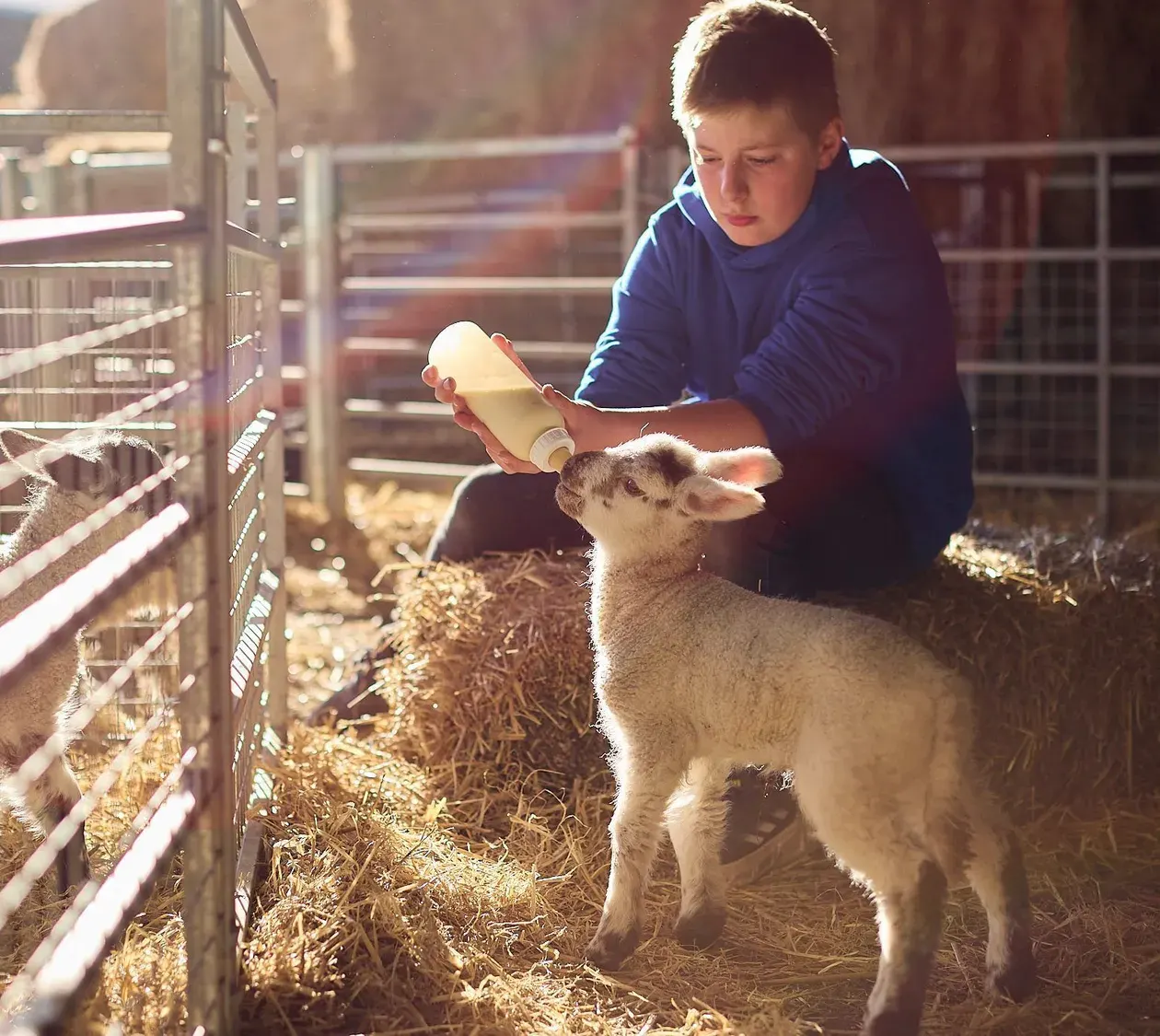
- Crouch down and let the lamb stand on all four legs. Never cradle it on its back like a baby.
- Hold the bottle firmly in both hands, tilted so the lamb's head comes up a little, just as it would reach up to a ewe.
- Let it set the pace, and expect a few hard head butts.
- Stop when the bottle's empty, however much it begs, then wash your hands.
Little ones do best with a grown-up's hand wrapped round theirs, as a lamb can easily pull the bottle away. By day three, older children are usually reminding the farmer when feeding time comes round. Learn to bottle feed a lamb once and you'll be first to the barn every morning.
How much milk does a lamb drink?
Less than you'd think at each feed, and far more often. Farm vets in New Zealand give this as a typical guide; British farmers follow a similar routine, tweaked for their own flock and milk powder.
| Lamb's age | Milk per feed (ml) | Feeds a day | What you'll notice |
|---|---|---|---|
| First days (after colostrum) | 150 | 5 | Wobbly legs, tiny sips, lots of sleep |
| 3 to 7 days | 200 to 250 | 4 | Finds the teat straight away |
| 1 to 4 weeks | 250 to 300 | 4 | Nibbling hay, racing to the gate |
| 4 weeks to 2 months | 300 to 350 | 3 to 4 | Strong enough to knock a toddler over |
| Over 2 months | 400 | 2 to 3 | Mostly grazing until weaning |
Hay and a little grain-based creep feed go in the pen from the first week, because nibbling solid food gets a lamb's stomach working. By a couple of months old most are weaned onto grass. Clean bottles and teats at every feed matter too, as leftover milk breeds bacteria fast.
The rule children find hardest? No extra bottles.
Lambs with their mother drink small amounts many times a day. One gulping down a big feed is far more likely to get bloat, a painful build-up of gas. So when a lamb cries for seconds, the kindest answer is no.
Which of our farms let you help with the lambs?
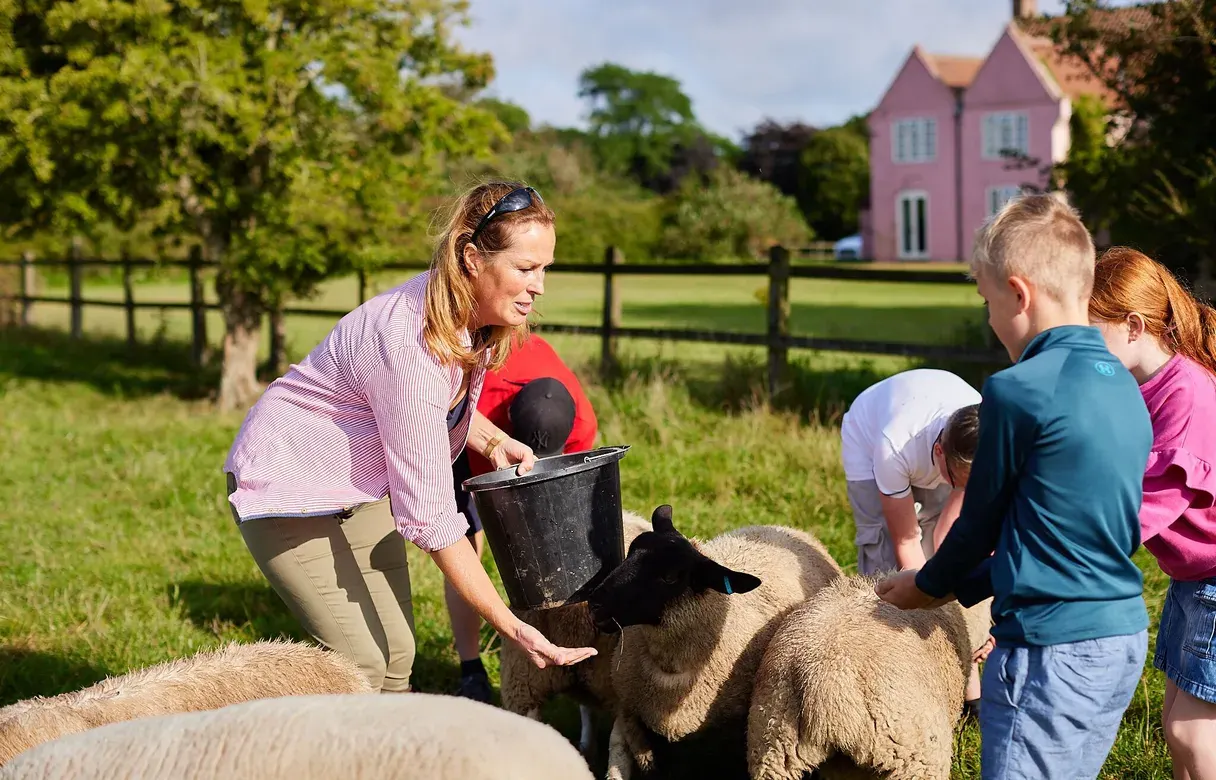
Each of these farms has spring lambs and says guests can often see, or join in with, feeding the pet lambs. It depends on how many orphans there are that year, so treat it as a lovely bonus rather than a booked activity.
| Farm | Area | What the farm says | Dogs | Stays from (£) |
|---|---|---|---|---|
| College Farm | Norfolk | The farmer may ask you to help feed the lambs in early April | No | 230 |
| Moor Farm | Gloucestershire | Lamb feeding listed, plus a regenerative farm tour | Yes | 250 |
| Foxglove Farm | Berkshire | Rare sheep breeds; newborns and bottle feeds in spring | Yes | 260 |
| Layer Marney Tower | Essex | Guests may help with the bottle lambs in spring | No | 260 |
| Warren Farm | Somerset | Sheep and beef farm; newborns and bottle feeds in spring | Yes | 260 |
| Lunsford Farm | East Sussex | Often the chance to meet and feed the spring lambs | No | 295 |
| Sunninglye Farm | Kent | Newborns and bottle feeds in spring | Yes | 345 |
| Gwel Teg Farm | Cornwall | Sheep lamb in spring; you can often watch the feeds | Yes | 400 |
College Farm near Beccles, rated 9.8 by guests, is the one to pick for the Easter holidays, as its lambs usually take their first steps in early April. At Layer Marney Tower early risers can head out with Nick on the morning feed round, then climb the Tudor tower for views to the sea when it's open. Dogs are welcome at Foxglove Farm, where Kathe and Simon keep rare sheep breeds and there's a country pub within walking distance. More stays in the east are in our Norfolk farm stays guide.
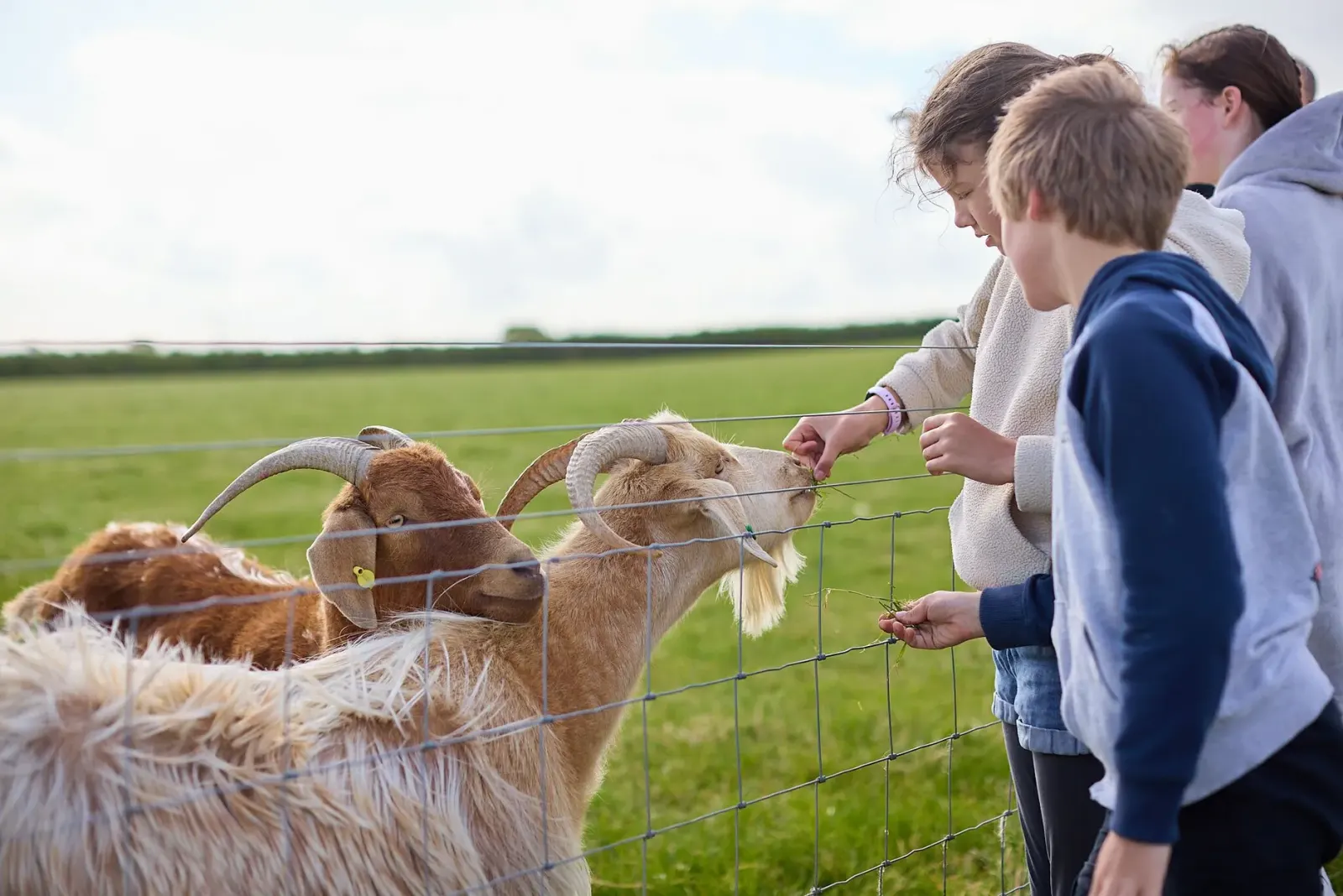
When can you feed the lambs?
March to May is the window. Lowland farms in the south lamb first, and there are usually a few still on the bottle into early summer. Our guide to lambing season explains why one farm runs weeks ahead of the next.
For a canvas farm stay, the Easter holidays and the May half term hit the sweet spot: small lambs, lighter evenings and a wood burner in the tent to take the chill off at bedtime.
Staying safe in the lambing barn
- Wash hands with soap and running water straight after feeding and before eating. The NHS hand washing guide is worth showing the kids before you go.
- Keep fingers, dummies and snacks away from mouths in the barn.
- Leave wellies at the tent door and barn clothes out of bed.
- If you're pregnant, UK government advice is to avoid contact with newborn lambs, ewes that are lambing and anything from the lambing shed. Watching from the field gate is fine.
What to bring for lamb feeding
- Wellies for everyone, plus spare socks
- An old coat without dangly toggles (lambs chew them)
- Clothes you don't mind covered in milk and straw
- A phone or camera on a wrist strap
- A head torch for the walk back from the barn
Book your spring farm stay
Feeding a lamb is the kind of hands-on experience children talk about long after the holiday photos are lost on a phone. Pick a farm from the table, browse all our family farm holidays, or start with the dog friendly farm stays if the dog's coming too. You'll find every farm we list on Farm Stays UK, with the animals, hot tubs and prices side by side.
Questions people ask
Can children bottle feed lambs on a farm stay?
Often, yes. Farms such as College Farm, Lunsford Farm and Layer Marney Tower say guests can help feed the spring lambs. It depends on how many orphans the farm has that year, so ask the farmer when you arrive.How old does a child need to be to bottle feed a lamb?
There's no fixed age on a farm stay, though farm parks usually set a minimum of four to six. Toddlers can join in with a grown-up holding the bottle too, as lambs pull hard.What milk do bottle-fed lambs drink?
Colostrum on the first day, then ewe milk replacer powder mixed with warm water, never cow's milk from the shop.How often does a lamb need a bottle?
Newborns have small feeds about five times a day, and from a week old it's usually four. That drops to two or three a day by two months, until the lamb is weaned onto grass and hay.Why can't I give a lamb an extra bottle?
Too much milk at once can give lambs bloat. It's a painful build-up of gas in the stomach. The farmer keeps track of every feed, so always ask first.Can I feed lambs if I'm pregnant?
UK government advice is to avoid contact with newborn lambs, lambing ewes and lambing shed clothing, though watching from the field gate is fine.When is the best time of year to feed lambs in the UK?
March to May. The Easter holidays and the May half term are the best times for a family farm stay, when most farms with lambs still have a few on the bottle.Find your farm stay
Compare every farm by animals, showers, hot tubs and dog rules.